


All About Attar
- UDAY NAIK
- Aug 8, 2020
- 11 min read

Long before a real life romance inspired the building of the Taj Mahal, India had seen another real life romance playout in the royal family. The love story between Nur Jahan and Jahangir led to the expansion of the mughal empire, religious freedoms, increased rights for women, and the discovery of Attar or Itra.

Nur Jahan was born on 31 May 1577 in Kandahar, present-day Afghanistan, into a family of Persian nobility and was the second daughter and fourth child of the Persian aristocrat Mirza Ghias Beg and his wife Asmat Begum. For unknown reasons, Ghias Beg's family had suffered a reversal in fortunes in 1577 and soon found circumstances in their homeland intolerable. Hoping to improve his family’s fortunes, Ghias Beg chose to relocate to India where the Emperor Akbar's court was said to be at the centre of the growing trade industry and cultural scene. Half way along their route the family was attacked by robbers who took from them the remaining meager possessions they had. Left with only two mules, Ghias Beg, his pregnant wife, and their three children (Muhammad, Sharif and Asaf ) were forced to take turns riding on the backs of the animals for the remainder of their journey. When the family arrived in Kandahar, Asmat Begum gave birth to their second daughter. The family was so impoverished that they feared they would be unable to take care of the newborn baby. Fortunately, the family was taken in by a caravan led by the merchant noble Malik Masud, who would later assist Ghias Beg in finding a position in the service of Emperor Akbar. Believing that the child had signaled a change in the family’s fate, she was named Mehr-un-Nissa meaning ‘Sun among Women’. Her father was appointed Diwan (treasurer) for the province of Kabul. Due to his astute skills at conducting business he quickly rose through the ranks of the high administrative officials. For his excellent work he was awarded the title of Itimad-ud-Daula (Pillar of the State) by the emperor. As a result of his work and promotions, Ghias Beg was able to ensure that Mehr-un-Nissa (the future Nur Jahan) would have the best possible education. She became well versed in Arabic and Persian languages, art, literature, music and dance.
As a teen, she married a soldier who left her a widow with a daughter. In 1607 she became a lady-in-waiting at court, which is where she met Jahangir, who at that point was the Mughal Emperor. When Jahangir married Mehr-un-Nissa he gave her the name Nur Jahan, which means “Light of the World.” Jahangir made Nur Jahan his most favored wife and gave her high levels of power.
When Jahangir died, two of his sons fought each other for the throne. Nur Jahan sided with Prince Shahryar. She hoped that she could continue to reign through him. However, her own brother sided with the other son, Shah Jahan, and helped Shah Jahan to victory. Shah Jahan placed Nur Jahan under house arrest, where she designed gardens and memorials and wrote poetry under the name ‘Makhfi.’
Politicians generally leave small legacies to history. It’s the artists and inventors and discoverers who really change the world. And Nur Jahan was no slouch in this area either. Besides gardens in Lahore, she is associated with the discovery of attar of rose.
Attar of Rose is the basis for an entire world of perfume. The story as authored by Jahangir himself (1605-1627) in his autobiographical work, “Tuzuki Jahangiri”, goes that once Asmat Begam, the mother of his wife Nur Jahan, was making rose water when she noticed a thick mass on the surface of pots where hot rose water was poured from jugs. Asmat collected the mass and finally realized that it was so rich that a single drop of it rubbed into the palm filled the air with an enchanting scent of tons of red roses blooming simultaneously. Jahangir was charmed by this delightful fragrance. There is no other scent that could compare to it. It lifts the spirit and refreshes the soul. As a token of gratitude for this discovery, Jahangir presented the discoverer with a pearl necklace. Akbar’s wife Empress Salima Sultan Begam named this essential oil Jahangiri Itra (Jahangir’s perfume).
It sounds about right, but since all anecdotes are improved by attaching them to someone more famous, this story, suitably modified, went to Asmat Begam’s daughter, Nur Jahan. In this version, Nur Jahan had a spat with her husband and once passions had cooled down a bit, she decided to throw a party as a make up gesture. To this end she ordered several large vats of rosewater prepared and woe betide anyone who tampered with them. In the heat of the day, she nodded off. The sun broke down the roses’ essential oils and when she awoke, she saw a layer of film on the surface. She assumed someone had thrown fat in the tanks until she tested the stuff. Immediately she rubbed the scum all over her clothing and ran off to tell her husband about this wonderful discovery, and we can hope, found better things to do than throwing a mere party.
The West is more familiar with the version of Italian traveller Niccolao Manucci (1639–1717) who lived in the Mughal palace much later, based on which Attar was allegedly discovered by Nur Jahan, the daughter of Asmat Begam, not Asmat herself. According to this legend, crushed rose petals used to be poured into the bath tubs while Shahi Hamam (the Royal Baths). One morning Nur Jahan noticed an oily substance floating over the surface of the water. It was a sort of eureka as the most exquisite "rooh gulab" was discovered.
Whatever is the legend, in any event, Nur Jahan was exiled to a quiet retirement at Lahore, surrounded by gardens and free to pursue her mother’s passion of making perfume. Attar or Itra (meaning: perfume) was thus born. Nur Jahan died in 1645.
During the Mughal era , scents were not only used on the body but also burnt in the mahals to embalm the air. Incense was daily burnt in the harem in gold and silver censors of various beautiful shapes and designs. Besides these, sweet-smelling flowers were used in large quantities. Araqs, itras and oils were extracted from the flowers. When Shah Jahan was being initiated into the mysteries of sex, it is said that his body was massaged by female attendants with exotic oils. Before Mumtaz Mahal's marriage to him, Arjumand Bano Begum, as she was known then, was anointed with scents similarly. If gossip be true, there was a Mir Attar in Bahadur Shah Zafar's time, to spread fragrance in the harem. It is a fact that beauty alone does not attract a person if the object of his desire perspires with a bad odour.
The Mughals who excelled in nearly everything that they did made perfumery into a fine art. Chameli, mogra, champa, molshri, juhi, nargis, harsinghar, gul-e-zafran, gulab, kamal, kamalini (lily), tasbih-e-gulal, hina and malti were some of the fragrant flowers that were cultivated in Mughal gardens and their scents extracted. Ambar-e-Ashab, cost one to three gold mohurs per tola in Akbar's reign. Zabad (civet scent) up to one gold mohur per tola. Mush-e-Muskh up to Rs 4.5 per tola (at a time when the rupee was 1000 times its present value). Then there were araq-e-gulab, araq-e-muskh, arq-e-bahar, arq-e-chameli and loban.
The maharaja palaces of Gwalior, Patiala, Darbhanga and Mysore were also famous for their itra. Jasmine and Sandal itra were more popular in southern region. The heights of the perfume making art were reached at its peak by Shia Nawabs of the Kingdom of Awadh situated on the banks of the River Gangas, who declared Lucknow to be their capital city. Under the rule of these Persophiles, who were dedicated to preserving their courtly manners, poetry, music and cuisine, Lucknow was renowned as Shiraz-e-Hindi or Shiraz of India (Al-Hindi).
The perfume making art flourished under Wajid Ali Shah, the last Nawab of Awadh who ascended the throne in 1847 and ruled for nine years up until the Great Uprising, which marked the end of the Mughal era in India and the start of the century of the British Raj. In the wake of marginalisation of traditional Indian culture by the British imperialists, the Persian Muslim civilisation lost its previous political positions.
However, after India became a secular republic, Al Hindi has survived to date not only in religion, Qawwali songs or the Urdu language but also in the rich scent of rose and other itra. “Ishk or mushk kabhi chupta nahi he,” they played on words in Lucknow, which meant “Love and musk are impossible to hide for long". Today Muslim weddings in Lucknow are still surrounded by the breathtaking scent of the famous Lakhnavi itra. Traditionally in the Eastern world, it was a customary practice of nobility to offer Attar to their guests at the time of their departure. Even Today, attar in beautiful Ittardan is a part of Eid decoration at homes. People offer their guests attar as a sign of love and brotherhood.
The sugandhis (perfumers) of Kannauj and Chandani chauk were greatly patronised by the latter Moghul emperors and made a fortune that way. Some of their shops still exist with fancy bottles of perfumes that waft you back to Moghul times.
Today, traditional attars are mainly distilled in Kannauj, in the Uttar Pradesh state in India. It has been protected under the Geographical indication (GI) of the Agreement on Trade-Related Aspects of Intellectual Property Rights (TRIPS) agreement. It is listed at item 157 as "Kannauj Perfume" of the GI Act 1999 of the Government of India with registration confirmed by the Controller General of Patents Designs and Trademarks. Due to the key role of perfume production in Kannauj, the city is known as "the perfume capital of India" and "Kannauj is to India what Grasse is to France". Kannauj has been the perfumery town of the country for thousands of years. The attar manufacture skill passed through generation to generation. When a craftsman explains about their family involvement in this industry, he says "My family has been working in this field since three centuries and my son is the 30th generation". They make from flowers and natural resources. Also musk, camphor, saffron and other aromatic substances are used for production. Flowers like white jasmine and plants like vetiver use for summer varieties while soil uses for monsoon variety, known as Mitti attar that gives the scent of wet earth. Heena attar and musk attar are winter varieties. The natural perfume has free of alcohol and chemical, except for some productions. Fragrant attar from rose has more smell while attar that made from sandalwood oil has lasting smell.
The attar manufacturing for floral type takes place in remote places because the flowers are required to be processed quickly after plucking. The apparatus & equipment used for manufacture of attar are light, flexible, easy to repair with a fair degree of efficiency, keeping in view the above facts, the traditional Deg & Bhapka process is being used for centuries and even now. The details of equipments used in the process are as follows:-
• Deg or Still: The process is carried out in copper stills called “Degs” as was done centuries ago. The lid of the still is called “Sarpos” and is also made of copper having opening for connections to one or two receivers.
• Bhapka or Receiver: The receiver is built of copper and is of round shape with long neck, for case in connection with Deg via Chonga. It is known as Bhapka and it acts as condenser as well.
• Chonga or Bamboo Condenser : The still and receiver are connected by a Chonga. This is a hollow bamboo pipe wrapped with twine for insulation.
• Traditional Bhatti or Furnace : It is made up of bricks and clay. Normally wood or coal is used for heating. Heat is controlled manually.
• Gachchi or cooling water tank : This is the place where Bhapka, or receiver is kept and used for cooling the distillate from Deg.
• Kuppi or leather bottle : These are the bottle made from leather of animals. The reason for making these bottles is their semi-permeability towards water. It is used for removal of moisture from attars.
Raw Materials and their Sources:
Base Material : Sandal wood oil, Di-octyl Phthalate (DOP) & Liquid paraffin. Floral Material: Flowers of Gulab, Kewra, Bela, Mehndi, Kadam, Chameli, Marigold, Saffron & Maulshri. Herb & Spices: A number of herbs and spices are used in this industry which includes Oakmoss, Sugandh mantra, Laurel berry, Juniper berry, Cypriol, Indian valerian, Jatamansi, Hedychium spicatum, Daru Haldi, Sugandha Bala, Sugandha Kokila, Kulanjan, Javitri/Jaiphail, Cardamom, Cloves, Saffron, Ambergris & Musk. Sources: Sandal wood oil – South India, Rose, Aligarh (U.P.), Palampur (H.P.), Kewra – Ganjam (Orissa).
Manufacturing Process:
The attars are made using the centuries old copper vessels called Deg (Kettle) or Stills and Bhapka (Receiver). The Deg & Bhapka system is based on hydro distillation technique is also made of copper having openings for connections to one or two receivers. The Deg capacity range between 10 and 160 Kilos of floral/herbal material. First, filing the plant in the Deg with the requisite amount of water, the lid is sealed with a mixture of cotton and clay. The Deg is heated on wood and cow dung cakes fire. The temperature is controlled by putting in more wood/cow dung cakes or by removing the same. While boiling the raw material in the Deg there is considerable increase in pressure inside the Deg. To prevent the lid from blowingoff, a leaf spring called Komoniis used on the top of the lid. The Bhapka is copper made and generally round in shape with a long neck. The fragrance of flowers (raw material) is obtained by condensing vapours into the base material, which is primarily sandalwood oil.
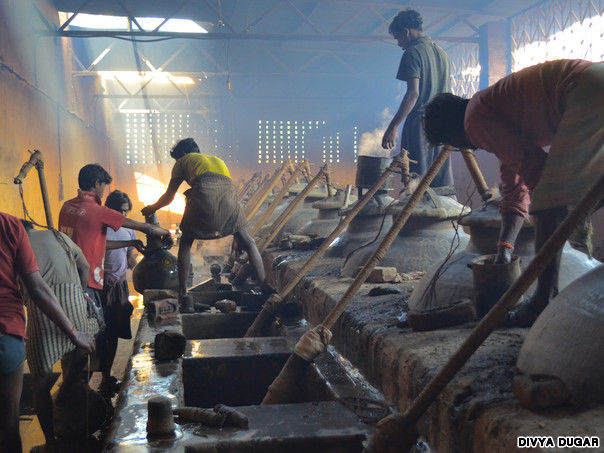
The Deg and Bhapka are connected by a Chonga. The chonga acts as a condenser. The mouth of the Bhapka is sealed by wrapping coarse cloth around the bamboo pipe and pushing it inside the condenser. The Bhapka may contain up to 5-10 Kilos of base material and is kept cool in a small water tank. The distillation is managed by highly experienced and skilled workers known as Dighoo. The Dighoo knows by experience when enough vapours have been condensed inside the Bhapka. The water of the tank inside of which Bhapka placed is changed continuously to keep the Bhapka cool, when the desired quantity of vapours get condensed, the Dighoo rubs wet cloth around the body of the still for a temporary pause in distillation and the filled Bhapka is replaced by another Bhapka. The Bhapka is then allowed to cool. The mixture of oil and water is then separated either directly from the Bhapka through a hole at the bottom or pouring the mixture in an open trough. After the oil and water have been separated as two different layers, the water is removed for an opening in the bottom which goes back to the Deg. The base material remains in the Bhapka. If the desired concentration of attar is achieved, then the final attar is poured into leather bottles, known as Kuppi, made of buffalo or camel leather for sedimentation and removal of moisture from the attar. If the desired concentration level is not achieved in the attar, then the attar is poured sback to the Bhapka. The Bhapka is then attached to the Deg and the above explained process is repeated till the desired attar concentration is not achieved
Attars are made with flowers, leaves, barks, roots etc of plants and tree particles and their base is mostly Sandalwood oil. Some of the attars available in market today may contain synthetic aroma ingredients due to the scarcity of natural materials. e.g. most of the Musk Attar available in market today are based on synthetic aroma ingredients since obtaining musk odorants by killing Musk Deer is impossible. Also due to the shortage of sandalwood and its high cost, many of the attar available in market today are derived using mineral oil as base instead of sandalwood oil.
Some of the popular attar are as follows.
Ruh Kewara, Ruh Khus, Ruh Mogra, Ruh Gulab, Jasmine, Jasmine Sambac, Jasmine attar phool, Jasmine Grandiflorum, Motia, Majmua, Attar Mitti, Heena, Kasturi Heena, Musk Heena, Heena Zafrani, , Heena Oudhi Attar, Gul Henna Attar, Heena Ambari Attar, Zafran (Saffron), Zafri Attar (Mari Gold-Genda Attar), Amber Attar, Bakhoor Attar, Dehnal Oud, Rooh-Al-Oudh, Mukhallat, Fancy Bouquet, Fantasia, Jannat-ul-firdaus, Sandalwood, Shamama, Sultan, Sultan Pasha, Musk, Musk Amber, Musk Gazala, Nag Champa, Nakh Choya, Narcissus , Osmanthus, Darbar, Red Rose, Arabian night, Arabian Princess, Arabian Rose, Arabian Saffron (Mukhalat Style) etc and many more.
Indian Attar or Itra (perfume) has local and international markets. These are exported to countries such as UK, USA, UAE, Saudi Arabia, Iran, Iraq, Singapore, France, Oman, Qatar, etc.
REFERENCES
International Journal of Interdisciplinary Research in Science Society and Culture (IJIRSSC) Vol: 2, Issue:1, (June Issue), 2016. Traditional Method of Making Attar in Kannauj. Saba Tabassum, Prof. S. Asif , A. Naqvi Research Scholar, Department of Museology, AMU Aligarh Professor, Department of Museology, AMU Aligarh
islamhashtag.com/the-best-attar/, What is Attar ? How to choose the Best Attar
Ittar, From Wikipedia, the free encyclopedia
https://www.fragrantica.com/news/Attar-in-India-An-Introduction-6355.html, Attar in India: An Introduction, by Naheed Shoukat Ali.

Comments